
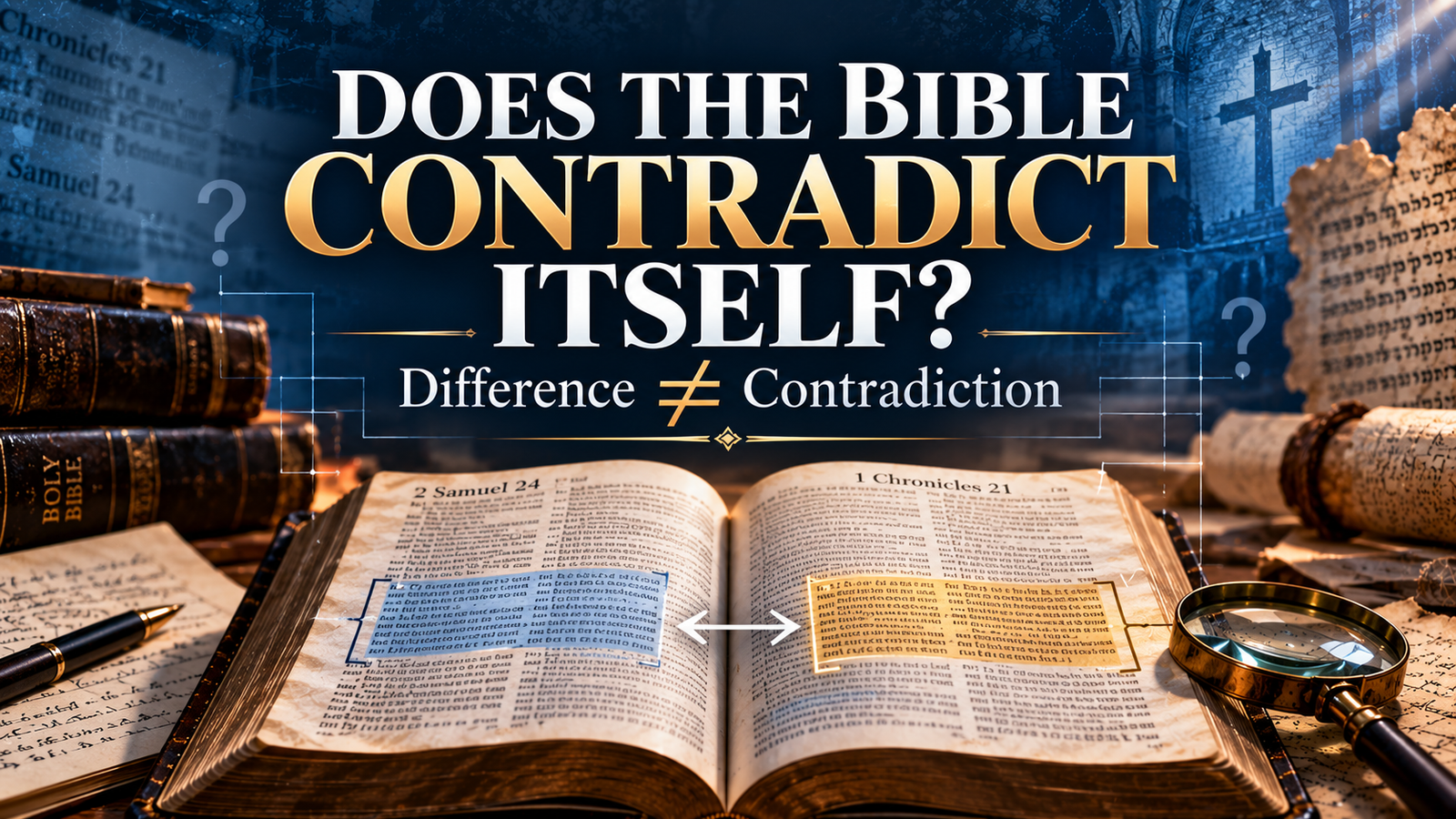
Critics of Christianity have compiled lists containing hundreds of alleged Bible contradictions. Christians sometimes respond with equally long lists of harmonizations. Neither approach necessarily answers the most important question: what actually counts as a contradiction?
If Christians believe Scripture is true, difficult passages should not frighten us. They should make us read more carefully. But defending the Bible does not require an invented scenario every time two passages differ. A responsible approach separates genuine contradiction from different perspectives, selective reporting, literary compression, textual variants, translation questions, and theological interpretation. Sometimes the evidence simply does not allow certainty.
What Is a Real Contradiction?
A contradiction exists when two claims assert mutually exclusive propositions about the same subject, at the same time, and in the same relevant sense. In simplified form, one account would need to affirm A while another denies A under the same conditions. Merely supplying different information is not enough.
Suppose one witness says, “Mary went to the tomb.” Another says, “Mary and another woman went to the tomb.” Those statements do not contradict each other because the first never says Mary went alone. The conflict would become real if one source said, “Only Mary was present,” while another placed additional women there at the same moment.
This elementary distinction is often lost in online debates. A difference may deserve explanation without constituting a contradiction. At the same time, Christians should not misuse that principle by adding imaginary details merely because those details would make two accounts compatible.
A Better Method for Testing Alleged Bible Contradictions
Before deciding that two passages contradict each other, ask a series of questions. Are they describing the same event? Are they answering the same question? Does either passage actually deny what the other affirms? Are translation choices obscuring the underlying Hebrew or Greek? Is there a known textual variant? Is one writer summarizing, rearranging, or selecting details for a particular literary purpose?
Then ask a harder question that apologetics sometimes avoids. Does evidence support the proposed reconciliation, or is it merely imaginable? Logical possibility can defeat a claim of strict contradiction. A persuasive historical explanation requires more. We should prefer explanations grounded in language, context, genre, ancient writing practices, manuscript evidence, or known patterns of narration.
Finally, identify the appropriate conclusion. A case might involve compatible accounts, a plausible reconciliation, a textual issue, an interpretive issue, or historical uncertainty. Some cases may remain genuinely difficult. These categories are more useful than forcing every example into “contradiction” or “no problem at all.”
Do Different Details Mean Two Accounts Contradict?
No. Independent or partially independent accounts regularly select different details. Historians do not expect separate narratives to contain identical information in identical order. In fact, word-for-word uniformity can raise a different historical question: whether one source simply copied another.
The Gospels provide many examples. One writer may mention a person another omits. One may preserve a longer saying while another abbreviates it. One may arrange material topically while another emphasizes chronology. Michael Licona compares these differences with techniques found in ancient Greco-Roman biography. His Oxford University Press study argues that accepted literary practices can explain some variations without requiring factual contradiction.
This does not mean “ancient biography” explains every discrepancy. Craig Blomberg has cautioned against one-size-fits-all harmonization. He specifically warns against multiplying events simply because two accounts appear difficult to reconcile. We must evaluate each passage individually.
Example 1: Who Incited David to Take the Census?
Second Samuel 24:1 and 1 Chronicles 21:1 present a genuine interpretive difficulty. In Samuel, the anger of the LORD burns against Israel. The text then says David is incited to take the census. Chronicles instead says that satan stood against Israel and incited David. Translators and interpreters debate whether the term means an adversary or Satan.
One traditional reconciliation distinguishes ultimate from secondary agency. On this reading, God sovereignly permits or commissions an adversarial agent to incite David directly. The book of Job offers a comparable distinction between God’s sovereignty and the satan’s immediate action. Paul Evans argues that the Chronicler’s divine intermediary need not represent an autonomous evil power outside God’s control.
Other scholars read Chronicles as a theological rewriting of Samuel. On that view, the Chronicler shifts immediate responsibility away from God. Another literary study draws parallels with Numbers 22. It argues that the Chronicler may have envisioned an adversarial divine messenger rather than the later fully developed figure of the Devil.
Assessment: interpretive issue, plausibly reconcilable, but disputed. The two texts unquestionably attribute the incitement differently at the narrative level. A model of primary and secondary causation can make the accounts compatible, but Christians should acknowledge that scholars debate why Chronicles changed the wording.
Example 2: How Did Judas Die?
Matthew 27:5 reports that Judas threw the silver into the temple, departed, and hanged himself. Acts 1:18 describes Judas acquiring a field and falling headlong, with his body bursting open. Matthew says the chief priests bought the potter’s field with the returned money, while Acts connects the field with Judas.
A familiar harmonization says Judas hanged himself and his body later fell and ruptured. That sequence is physically possible. Likewise, the priests could make a purchase with Judas’s money while Acts attributes the field to Judas. These possibilities show that the statements are not logically impossible to combine.
But historical analysis must go farther than possibility. Modern scholars often treat Matthew and Acts as distinct traditions about Judas’s death. Each account has its own scriptural and theological presentation. Dennis MacDonald, for example, notes shared elements but emphasizes Luke’s literary shaping of the account.
Assessment: the accounts are plausibly reconcilable at the level of logical compatibility, but the precise sequence remains historically uncertain. Scripture gives us two different descriptions. The common hanging-then-falling reconstruction may be correct. However, neither passage explicitly supplies the complete sequence. We should distinguish what the texts say from a reconstruction that connects them.
Example 3: Do the Resurrection Accounts Contradict One Another?
The Resurrection narratives differ in several details. They name different women, emphasize different angelic figures, and narrate appearances in different ways. They also give attention to different locations. Critics often present these variations as proof that the accounts cannot all be historical.
Yet selective reporting matters. Naming Mary Magdalene does not mean she was alone. Mentioning one speaking angel does not deny the presence of another. Narrative emphasis can also explain why one Gospel concentrates on Jerusalem while another emphasizes Galilee. Even so, scholars still debate some chronological details and how the evangelists shaped inherited traditions.
We cannot settle the historical question by counting surface differences. Some scholars favor harmonizing approaches. Others use source-critical models that emphasize distinct traditions and redaction. Recent scholarship continues to reflect this divide. Some researchers construct a unified narrative, while others conclude that certain details resist reconciliation.
Assessment: many alleged contradictions are compatible differences, while some sequencing questions remain debated. None of this erases the shared central claims: Jesus was crucified, died, was buried, His tomb was reported empty, and His followers proclaimed appearances of the risen Jesus. For the historical case itself, see Did Jesus Really Rise From the Dead?
What About Different Numbers, Names, or Chronologies?
Numerical and chronological differences require their own category. Scribes copied ancient manuscripts by hand, and numbers can be vulnerable to textual corruption. Other differences have different causes. Authors may count groups differently, round figures, use different calendars, or begin reigns from different reference points. They may also organize events for literary purposes rather than strict chronology.
That does not authorize us to invoke “copyist error” whenever a number becomes inconvenient. Textual critics compare manuscripts, ancient translations, quotations, and relationships among witnesses. They also weigh internal evidence to determine whether a variant is likely secondary. Where manuscript evidence supports a textual problem, we should say so. Where it does not, we need another explanation.
This distinction also protects the doctrine of Scripture from a category error. Christian claims about inspiration concern the text God gave through human authors. A demonstrable scribal variant in a later manuscript concerns transmission. It does not automatically create a contradiction in the biblical author’s original composition. Our broader discussion appears in Why the Bible Can Be Trusted.
Can Christians Harmonize Too Much?
Yes. Christians weaken a defense of biblical truth when they treat every conceivable harmonization as established history. Saying “perhaps this happened” can demonstrate logical compatibility. It cannot prove that the proposed event actually happened.
Suppose two accounts differ. A defender might invent three undocumented events that allow both narratives to remain literally true. Those events could defeat a claim of strict logical contradiction if they are genuinely possible. But possibility is not proof. Without support from language, context, ancient practice, or external evidence, we should label the reconstruction as a possibility rather than fact.
Christian confidence does not require pretending every difficult passage has an obvious solution. Some questions remain difficult because our evidence is incomplete. Intellectual honesty means stating the limits of the evidence while continuing to investigate the text. That is not surrender. It is exactly the standard we should demand when evaluating claims from any worldview.
Does One Unresolved Difficulty Disprove the Bible?
An unresolved difficulty is not the same as a demonstrated contradiction. Two passages may resist a persuasive reconciliation. In that case, the responsible conclusion may simply be that we do not yet know how they relate. Historical knowledge is often incomplete, especially with texts written thousands of years ago.
At the same time, Christians should understand the stakes of a genuine contradiction. Suppose two biblical authors make mutually exclusive assertions about the same matter in the same sense. That would raise a real theological question for strong doctrines of biblical inerrancy. We should not redefine contradiction so broadly that no evidence could ever count against our position.
Instead, put the claim to the test. Read both passages in context. Examine the original-language issue when relevant. Check the manuscript evidence. Understand genre and ancient literary practice. Consider the strongest critical argument and the strongest responsible reconciliation. Then state only what the evidence allows.
What Does the Evidence Establish?
The Bible contains many differences between parallel accounts. Difference alone is not contradiction. Selective detail, perspective, literary arrangement, paraphrase, primary and secondary agency, and textual transmission can explain many alleged conflicts without sacrificing historical truth.
Some proposed contradictions are weak because one passage never denies what the other says. Other cases are genuinely difficult and support more than one scholarly explanation. Sometimes manuscript evidence identifies a transmission problem instead of a conflict in the underlying composition.
The evidence does not justify either extreme. We should not call the Bible contradictory whenever two sentences differ. We also should not call every harmonization proven simply because it preserves compatibility. The strongest Christian case distinguishes certainty, probability, possibility, and unresolved questions.
Conclusion: Test the Contradiction, Not Just the Claim
Does the Bible contradict itself? Lists of alleged contradictions do not answer that question. We must test each claim. A genuine contradiction requires more than variation. Two passages must make mutually exclusive claims under the same relevant conditions.
Christians should approach these questions with confidence and humility. Careless harmonization does not strengthen Scripture. Labeling every difference a contradiction does not strengthen skepticism either. Truth deserves a higher standard from both sides.
If you are testing whether Christianity can withstand serious scrutiny, continue with Why Believe Christianity Is True?. Then examine what history tells us about Jesus of Nazareth. You can also explore the evidence for biblical reliability.
Related Reading
- Why the Bible Can Be Trusted: Evidence of Divine Authorship
- Did Jesus Really Rise From the Dead? Examining the Historical Evidence
- Who Was Jesus, Really? Separating History from Myth
- Why Believe Christianity Is True? Examine the Evidence
Sources and Further Reading
- Michael R. Licona, Why Are There Differences in the Gospels? What We Can Learn from Ancient Biography, Oxford University Press, 2017.
- Craig L. Blomberg, “How to Approach Apparent Contradictions in the Gospels: A Response to Michael Licona,” Christian Research Journal 40.2.
- Paul S. Evans, “Divine Intermediaries in 1 Chronicles 21: An Overlooked Aspect of the Chronicler’s Theology,” Biblica 85 (2004): 545–558.
- Evelyn Y. Tollerton, “God or Satan: A Literary Study of 1 Chronicles 21:1,” Andrews University Seminary Scholarship Symposium, 2017.
- Dennis R. MacDonald, Does the New Testament Imitate Homer? Four Cases from the Acts of the Apostles, Yale University Press, 2003, chapter on Judas.
- William P. Alston, “Biblical Criticism and the Resurrection,” in The Resurrection: An Interdisciplinary Symposium on the Resurrection of Jesus, Oxford University Press, 1998.