
Did Jesus Really Rise From the Dead? Examining the Historical Evidence
Christianity stands on an extraordinary claim: Jesus Christ died on a Roman cross and bodily rose from the dead. Christians do not believe Jesus merely survived through His teachings or lived on in the memories of His followers. We believe He conquered death, left the tomb empty, and appeared alive afterward.
That claim sits at the very center of the Christian faith. If Jesus remained dead, Christianity loses its foundation. The apostle Paul openly acknowledged this when he wrote that Christian faith becomes futile if Christ has not risen. But if the historical case succeeds, a second question follows: does the Resurrection actually prove Christianity is true?
At CHPTRXV, we believe Jesus Christ is the Son of God, fully God and fully man. He died for our sins, rose bodily from the dead, and lives today. Yet Christianity does not ask anyone to ignore history when considering those claims.
The Resurrection entered history as a claim about something that actually happened. That gives us something we can investigate.
What happened after Jesus was crucified? How early did Christians begin proclaiming His Resurrection? Why did His followers believe they encountered Him alive? What happened to skeptics such as James and enemies such as Paul?
Most importantly, what explanation best accounts for the evidence?
Christianity Rises or Falls With the Resurrection
The Resurrection is not an optional addition to Christianity. Remove it, and Christianity collapses. Paul makes that remarkably clear in 1 Corinthians 15, where he says Christian faith becomes futile without the Resurrection.
Christianity therefore makes a claim that invites historical investigation. It does not simply ask us to embrace a philosophy or follow the teachings of a moral leader. Christianity declares that God entered human history through Jesus Christ, who suffered crucifixion, died, was buried, and rose bodily from the dead.
Paul summarizes the message he had received and passed to others:
“Christ died for our sins according to the Scriptures, that he was buried, that he was raised on the third day according to the Scriptures.”
1 Corinthians 15:3–4, NIV
Paul then names appearances to Peter, the Twelve, more than five hundred people, James, the apostles, and finally himself. This passage gives us one of the most important historical sources in the entire Resurrection investigation.
The question is whether the evidence supports what Paul proclaimed.
Did Jesus Really Die on the Cross?
Before asking whether Jesus rose from the dead, we first need to establish that He died. The New Testament consistently places His execution under Roman authority during the governorship of Pontius Pilate. Sources outside the New Testament also connect Jesus with execution under Roman rule.
The Roman historian Tacitus discussed Christianity while describing Nero’s persecution of Christians in Rome. Writing in the early second century, he traced the movement to Christus and his execution under Pontius Pilate. Tacitus had no interest in defending Christianity and openly expressed contempt for the movement.
That hostility makes his testimony particularly useful. A Roman historian independently knew that Christianity began with a historical founder executed during the reign of Tiberius. His account supports the basic historical framework preserved by the New Testament.
Modern scholars continue to debate the precise physiological causes of death during crucifixion. Researchers have proposed traumatic shock, respiratory failure, blood loss, and several interacting causes. We do not need to settle that medical debate to establish the central historical point.
Jesus underwent Roman crucifixion and died.
That creates an immediate problem for theories claiming Jesus merely fainted or lost consciousness. The Resurrection accounts do not describe a wounded man who slowly recovered from an execution attempt. They proclaim that the crucified Jesus defeated death itself.
For a broader investigation of Jesus outside the Resurrection question, see our examination of who Jesus really was.
Was Jesus Buried?
All four canonical Gospels connect Joseph of Arimathea with the burial of Jesus. Mark describes Joseph as a prominent council member who approached Pilate and requested Jesus’ body. Matthew, Luke, and John also preserve the Joseph tradition.
The burial matters because the earliest Christian proclamation concerns what happened after Jesus died. Christians did not begin with a vague belief that His spirit somehow continued beyond death. They proclaimed a bodily Resurrection.
Paul’s early summary follows the same sequence. Christ died, He was buried, He rose, and He appeared to witnesses. The burial therefore connects the historical Crucifixion with the Resurrection proclamation that immediately follows it.
Some scholars question individual details surrounding the burial, so we should not pretend that every point escapes debate. Historical investigation rarely gives us that luxury. Nevertheless, burial belongs to several early strands of the Christian tradition and appears directly in Paul’s Resurrection summary.
Was Jesus’ Tomb Empty?
The empty tomb deserves careful treatment because scholars debate its historical certainty more than popular apologetics sometimes suggests. All four canonical Gospels nevertheless place women at the discovery of the empty tomb. Although their accounts emphasize different details, women remain central throughout the discovery traditions.
Christian apologists often argue that this detail supports authenticity. Ancient Jewish society generally gave men greater public and legal authority, making female discoverers an unusual choice for an invented story. The argument has merit, although ancient attitudes toward female testimony were more complicated than some apologetic summaries imply.
The broader pattern matters more than a single argument about women. The Gospels connect Jesus with a specific burial and then describe His tomb as empty. Christians soon proclaimed His Resurrection within the same historical environment where His execution had occurred.
An empty tomb by itself would not prove that Jesus rose from the dead. Someone could propose several natural explanations for a missing body. Its significance increases when we consider the empty tomb alongside the appearance traditions and earliest Christian proclamation.
That cumulative evidence becomes much harder to dismiss.
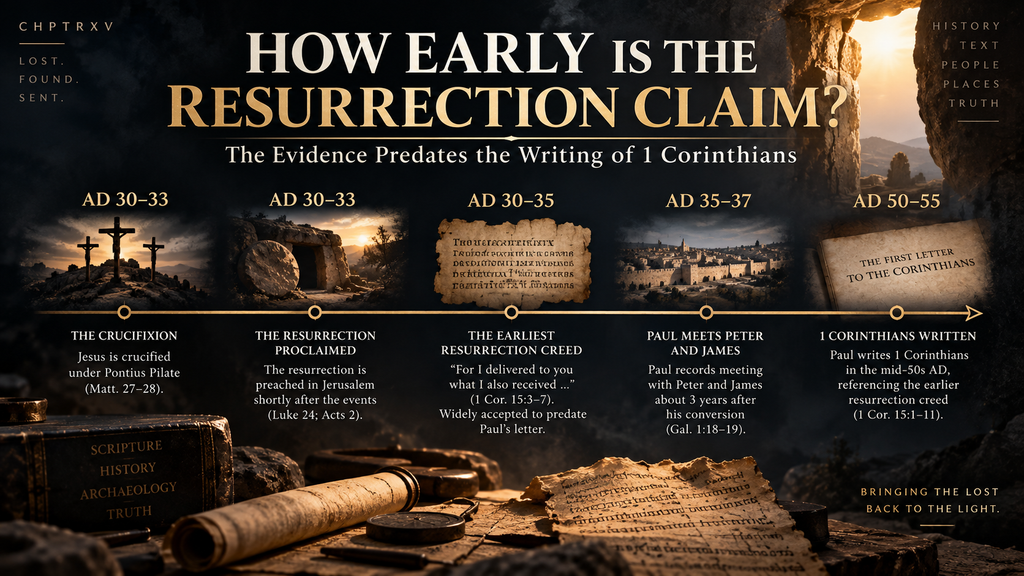
How Early Did Christians Claim Jesus Had Risen?
Critics sometimes portray the Resurrection as a legend that developed generations after Jesus died. The surviving evidence creates a serious problem for that explanation. Resurrection belief appears extremely early within Christianity.
Paul wrote 1 Corinthians around the middle of the first century. However, he tells his readers that he had already received the Resurrection message before passing it to them. His language in 1 Corinthians 15:3–5 preserves what many scholars identify as an earlier Christian formula or confession.
Paul begins:
“For what I received I passed on to you as of first importance.”
1 Corinthians 15:3, NIV
He then summarizes Christ’s death, burial, Resurrection, and appearances. Paul therefore did not invent this message while composing 1 Corinthians. The tradition already existed.
Scholars debate exactly when Christians first formulated this material. We do not need to assign an exact year to recognize its historical importance. The evidence places Resurrection belief within Christianity’s earliest recoverable proclamation.
This severely weakens the claim that Christians invented the Resurrection centuries later. Someone can argue that the earliest Christians were mistaken about what happened. It is much harder to argue that belief in the Resurrection appeared only after generations of legendary development.
Did the Disciples Believe They Saw Jesus Alive?
Something convinced Jesus’ followers that He had risen. Paul’s early tradition names Peter and the Twelve before describing additional appearances. He also reports an appearance to more than five hundred people and later names James.
The Gospels preserve additional appearance traditions. Luke describes Jesus meeting His followers and eating with them. John records encounters involving Mary Magdalene, the disciples, Thomas, and others.
Historians interpret these accounts differently. Skeptical scholars may conclude that Jesus’ followers sincerely believed they experienced appearances without accepting a supernatural explanation. Christian scholars argue that the bodily Resurrection best explains those experiences.
That distinction matters because we should not claim history establishes more than the evidence allows. Historical investigation can examine what people reported, how early they reported it, and what they came to believe. The question then becomes which explanation best accounts for those facts.
CHPTRXV does not begin by assuming miracles cannot happen. If God exists, we cannot dismiss resurrection simply because it involves supernatural action.
What Happened to James?
James presents an especially interesting case because the Gospels portray Jesus’ brothers as skeptical during His ministry. John 7:5 states plainly that His brothers did not believe in Him. Yet James later became an important leader within the Jerusalem church.
Paul specifically names James among those who encountered the risen Jesus. Elsewhere, Paul describes meeting James personally. This gives us an early connection between James and the Resurrection proclamation.
The Jewish historian Josephus later mentions James when describing his death. He identifies him as the brother of Jesus who was called Christ. Scholars generally regard this reference to James as one of the more secure references to Jesus within Josephus.
We should still avoid claiming more than the sources tell us. Josephus does not say James became a Christian because he saw the risen Jesus. Paul supplies the appearance claim, while other early Christian evidence establishes James as a church leader.
Taken together, those facts create an important question. How did a skeptical brother of Jesus become a prominent leader in the movement proclaiming Him as the risen Christ?
The Resurrection provides an answer.
What Happened to Paul?
Paul presents an even more dramatic transformation. He did not begin as a follower who desperately wanted Christianity to survive. By his own testimony, he actively persecuted the church.
Then something changed.
Paul became one of Christianity’s most influential missionaries and endured considerable suffering while proclaiming Jesus. He spent the rest of his ministry advancing the movement he had once tried to destroy.
Paul tells us what changed his mind. He believed that he encountered the risen Jesus.
This evidence carries particular weight because Paul’s own letters survive. We do not depend entirely upon a story written centuries after his life. Paul personally tells his readers about his persecution of Christians and his encounter with Christ.
Any explanation of Christianity’s origins must account for Paul. Calling him sincere does not establish the Resurrection by itself. However, dismissing him without explaining his transformation does not answer the evidence either.
Did the Disciples Invent the Resurrection?
Perhaps the disciples knew Jesus remained dead and deliberately invented the Resurrection. This theory initially sounds simple because people certainly can lie. Yet intentional deception must explain several parts of the evidence.
A conspiracy would mean the original disciples knowingly proclaimed something they understood to be false. That explanation must then account for the early Resurrection tradition and the appearance claims. It also needs to explain figures such as James and Paul.
Christians sometimes argue that the disciples’ willingness to suffer proves the Resurrection. That argument needs greater precision. People throughout history have suffered and died for beliefs that were false.
Sincerity does not prove truth.
However, suffering for something you sincerely believe differs from suffering for something you personally fabricated. A conspiracy theory therefore needs evidence that the disciples knowingly invented their central proclamation.
Possibility alone does not establish conspiracy.
Were the Resurrection Appearances Hallucinations?
The hallucination hypothesis takes the disciples’ sincerity more seriously. Perhaps they genuinely believed they saw Jesus, but grief or psychological distress produced visionary experiences. Bereavement experiences occur, so this explanation deserves serious consideration.
A hallucination might explain an individual’s experience without requiring deliberate deception. That gives the hypothesis more explanatory value than a simple conspiracy theory. However, the Resurrection evidence involves more than one reported experience.
Paul preserves traditions involving Peter, the Twelve, James, a larger group, and himself. The Gospels contain additional appearance traditions in different settings. Any psychological explanation must account for the broader pattern rather than explaining only one person’s experience.
The hypothesis also leaves other evidence untouched. A hallucination does not remove a body from a tomb. It does not automatically explain why Resurrection proclamation emerged so early.
None of this means psychological explanations deserve ridicule. They should face the same standard as every other theory. The question is how much of the evidence they actually explain.
Did Someone Steal Jesus’ Body?
Another theory accepts an empty tomb but rejects the Resurrection. Perhaps someone removed Jesus’ body after the burial. Matthew itself preserves an accusation that the disciples stole the body, so this theory is hardly a modern invention.
Removing the body could explain an empty tomb. It cannot, by itself, explain why Jesus’ followers believed they encountered Him alive. That requires an additional explanation.
If the disciples stole the body, the theory becomes a conspiracy. If someone else removed it, the disciples could remain sincere about their later experiences. However, that version introduces an unknown person or group for whom we have no direct evidence.
The theory therefore explains one part of the evidence while leaving another major part unresolved. A complete explanation must address both the empty-tomb tradition and the appearance claims.
Could Jesus Have Survived the Crucifixion?
The swoon theory proposes that Jesus never truly died. Under this scenario, He survived crucifixion, recovered, and later appeared to His followers. This explanation faces significant historical and practical problems.
Roman authorities intended crucifixion to kill. Jesus had also endured severe physical trauma before His followers reported seeing Him afterward. Any survival theory must explain how He escaped execution and recovered sufficiently to appear to His disciples.
Even extraordinary survival creates another problem. A severely injured Jesus would not demonstrate victory over death. His appearance would show His followers that He had somehow survived and desperately needed medical care.
That bears little resemblance to the earliest Christian proclamation. The disciples did not announce that Jesus survived Rome.
They proclaimed that God raised Him from the dead.
Did the Resurrection Become a Legend?
Legendary development offers another alternative. Perhaps Jesus died, His followers mourned Him, and stories gradually grew around His memory. Later Christians could then have transformed those stories into bodily Resurrection accounts.
Ancient traditions certainly can develop over time. That makes chronology essential.
Paul’s testimony places Resurrection proclamation very early in Christianity. More importantly, Paul says he received the tradition before passing it to others. His letters also connect him directly with Peter and James, two people closely associated with Christianity’s earliest generation.
The timeline therefore creates a major problem for a late legend theory. Resurrection belief did not suddenly emerge centuries after Jesus. It existed while people connected with the earliest Christian movement were still alive.
Someone may argue that early Christians sincerely misinterpreted their experiences. That remains a different argument. The evidence does not support treating the Resurrection as a story invented generations after everyone involved had disappeared.
The belief appears far too early.
What About Differences Between the Resurrection Accounts?
Anyone who compares the Gospel accounts will notice differences. They describe different numbers of people at various moments and emphasize different details. They also arrange portions of the Resurrection narrative differently.
Christians should not hide those questions. Differences in detail do not automatically create contradictions because independent accounts often emphasize different aspects of an event. At the same time, we should not force difficult passages into artificial harmonies merely to eliminate every tension.
The central claims remain remarkably consistent. Jesus dies and receives burial. Women discover the tomb empty, and His followers subsequently encounter Him alive.
Those are the claims that matter most to the historical investigation. Questions concerning the reliability and transmission of Scripture deserve further examination. Our article explaining why the Bible can be trusted provides a useful starting point.
Can History Prove a Miracle?
This may be the deepest objection in the entire discussion. Some historians argue that historical methodology cannot conclude that God raised Jesus from the dead. Historians normally examine events through causes found within ordinary human experience.
We should recognize that methodological limitation without turning it into a philosophical conclusion. Saying historical methods cannot establish supernatural causation differs from saying supernatural events cannot occur. The second statement makes a much larger claim about reality.
If someone assumes God cannot act within creation, the Resurrection becomes impossible before the investigation even begins. Every piece of evidence must receive another explanation because the investigator has already removed one possibility.
But the evidence did not remove it.
The investigator did.
Christianity does not claim that dead people naturally rise. It claims that God raised Jesus from the dead. Understanding that distinction also matters when discussing the relationship between science and Christian faith.
If God exists, a miracle does not violate His ability to act within the creation He made.
What Explanation Best Accounts for the Evidence?
We can now consider the evidence together rather than isolating each piece. Jesus died by Roman crucifixion, and His followers soon proclaimed that He had risen. Resurrection belief appears within Christianity’s earliest recoverable message.
Early traditions associate Peter, the Twelve, James, Paul, and others with appearances of the risen Jesus. The Gospel traditions also preserve an empty tomb discovered by women. Christianity then emerged with the Resurrection at the center of its proclamation.
No single fact carries the entire argument. The historical case rests on the cumulative weight of several facts and traditions. Competing theories must therefore explain the complete picture.
A stolen body might explain an empty tomb, but it does not explain the appearance claims. Hallucinations might address some experiences, but they do not naturally account for every part of the evidence. Legendary development struggles with the early date of Resurrection belief.
The swoon theory must overcome Jesus’ Roman execution. A conspiracy must explain why the earliest witnesses knowingly proclaimed something they fabricated. Each alternative can address part of the evidence, but each creates additional questions.
The Resurrection brings those pieces together.
Jesus Christ Rose From the Dead
CHPTRXV does not conclude that Jesus merely might have risen. Jesus Christ rose bodily from the dead. The Resurrection stands at the heart of who He is and what He accomplished.
Jesus is the eternal Son of God, fully God and fully man. He willingly went to the cross and died for our sins. Death did not defeat Him.
He defeated death.
The empty tomb was not the beginning of a legend about a fallen teacher. The disciples proclaimed Jesus alive because they encountered the risen Christ. James went from unbelief to leadership, while Paul went from persecutor to apostle.
The Resurrection also explains why Christianity began with such a startling proclamation. The earliest Christians did not merely preserve the teachings of a dead rabbi. They announced that the crucified Messiah had risen and now reigns.
That claim remains central to why Christians believe Christianity is true.
What Does the Resurrection Mean for You?
Historical investigation can take us remarkably far, but Jesus never intended His Resurrection to remain an academic puzzle. If Jesus rose from the dead, then His identity and teachings demand our attention.
His claims about God matter. His teaching about sin matters. His promise of salvation matters, and His claim upon our lives matters.
You may have doubts about Christianity or questions that nobody has answered well. Perhaps you walked away from faith years ago. You may follow another religion, or you may believe no religion at all.
Ask the questions.
Read the Gospels and examine the evidence. Investigate the objections rather than accepting easy answers from either side. Christianity does not need you to avoid difficult questions.
But do not stop at the empty tomb.
Look at Jesus.
Luke 15 reveals a God who searches for the lost, welcomes those who return, and rejoices when they come home. That same God entered history in Jesus Christ, carried our sins to the cross, and conquered death.
The Christian proclamation that began nearly two thousand years ago remains unchanged:
He is risen.
And because He lives, the lost can still come home.
Sources and Further Reading
The New Testament: Matthew 27–28; Mark 15–16; Luke 23–24; John 19–21; Acts 1–4; 1 Corinthians 15; Galatians 1–2.
Tacitus, Annals 15.44. Roman testimony connecting Christus with execution under Pontius Pilate during the reign of Tiberius.
Josephus, Antiquities 20.200. Josephus identifies James through his relationship to Jesus, who was called Christ.
James Ware, “The Resurrection of Jesus in the Pre-Pauline Formula of 1 Cor 15.3–5,” New Testament Studies. Scholarly analysis of the early Christian confession preserved by Paul.
Sarina Odden Meyer, “The Heroines Are in the Details: Rediscovering the Women in the Resurrection Narratives.” Examination of women within the canonical Resurrection traditions.
“Medical Views on the Death by Crucifixion of Jesus Christ.” Review of proposed medical mechanisms involved in death by Roman crucifixion.
Related Reading
Why Believe Christianity Is True? Examine the Evidence
Who Was Jesus, Really? Separating History from Myth
Why the Bible Can Be Trusted: Evidence of Divine Authorship
Does the Bible Contradict Itself? How to Test an Alleged Biblical Contradiction