
Did Jesus Claim to Be God? What He Actually Said
One of the most common objections to Christianity sounds simple: Jesus never said He was God.
You will hear the argument from atheists, Muslims, Jehovah’s Witnesses, skeptics, and even some biblical scholars. The claim usually takes a particular form. If Jesus truly believed He was God, why did He never simply say, “I am God”?
It sounds like a reasonable question until we ask another one. What would claiming divine identity actually sound like within the Jewish world of Jesus?
Jesus did not speak to twenty-first-century Americans using modern theological formulas. He spoke among first-century Jews who knew Israel’s Scriptures, worshiped one God, and understood the significance of biblical titles and imagery. To understand what Jesus claimed, we must first understand the language He used.
When we do that, the picture becomes much clearer.
Jesus forgave sins. He claimed authority over the Sabbath. He spoke of existing before Abraham. He identified Himself with the heavenly Son of Man. He claimed a place at God’s right hand and said He would judge humanity.
In John’s Gospel, Jesus makes His divine identity even more explicit.
At CHPTRXV, we do not believe Jesus merely claimed to be God. Jesus Christ is God the Son, fully God and fully man. He shares the one divine essence with the Father and the Holy Spirit while remaining a distinct person within the Trinity. That raises the broader doctrinal question of whether the Trinity is actually taught in the Bible or was invented later by the church.
But Christianity invites us to examine why we believe that.
So what did Jesus actually say?
Did Jesus Ever Say the Exact Words “I Am God”?
No Gospel records Jesus speaking the exact English sentence, “I am God.”
That observation is true.
The conclusion often drawn from it is not.
Jesus also never said, “I am the second person of the Trinity, consubstantial with the Father.” Christians do not determine His identity by searching for one modern theological sentence. We examine the complete picture presented by His words, actions, titles, and use of Scripture.
The question therefore should not be whether Jesus used our preferred wording. We should ask whether His original audience would have understood His words and actions as claims to divine authority or identity.
That investigation takes us beyond a single proof text.
What Would Claiming to Be God Mean in Jesus’ Jewish World?
Jesus lived and taught within a thoroughly Jewish religious environment. Israel’s Scriptures emphasized the uniqueness of God repeatedly. Deuteronomy 6:4 declares that the Lord is one, forming the foundation of Jewish monotheistic confession.
Jesus affirmed that belief.
When asked about the greatest commandment, He began by quoting the Shema:
“Hear, O Israel: The Lord our God, the Lord is one.”
Mark 12:29, NIV
Christianity therefore does not teach that Jesus introduced another god alongside the God of Israel. Nor does the doctrine of the Trinity teach three gods. The Father, Son, and Holy Spirit share one divine essence while existing as three distinct persons.
This Jewish context also changes how we read Jesus’ claims. Certain actions belonged uniquely to God, while certain Old Testament passages described God’s authority and heavenly rule. Jesus repeatedly placed Himself inside those categories.
One of the earliest examples appears when a paralyzed man is brought before Him.
Why Did Jesus Forgive Sins?
Mark 2 describes four men lowering a paralyzed man through a roof so Jesus could reach him. Everyone expects healing, but Jesus initially does something more surprising.
He tells the man:
“Son, your sins are forgiven.”
Mark 2:5, NIV
The scribes immediately recognize the problem. They ask why Jesus speaks this way because only God can forgive sins.
Jesus does not correct their premise.
Instead, He asks which is easier: declaring someone’s sins forgiven or commanding a paralyzed man to walk. Jesus then heals the man to demonstrate that the Son of Man possesses authority on earth to forgive sins.
The scene deliberately connects forgiveness with Jesus’ authority. The scribes identify forgiveness as God’s prerogative, and Jesus responds by demonstrating His authority rather than withdrawing His claim.
That does not mean every scholar interprets the passage as a direct declaration of deity. Some understand Jesus as exercising authority delegated by God. The debate concerns what Mark intends Jesus’ authority to signify.
But the scene unquestionably forces the question.
Why does Jesus exercise an authority His critics associate with God?
Why Did Jesus Claim Authority Over the Sabbath?
The same pattern appears later in Mark.
Jesus’ disciples pick grain on the Sabbath, and the Pharisees challenge their behavior. Jesus responds by recalling David’s actions when he and his companions needed food.
Then Jesus makes a remarkable statement:
“So the Son of Man is Lord even of the Sabbath.”
Mark 2:28, NIV
The Sabbath did not originate as a human institution. Genesis connects the seventh day with God’s rest after creation, and the Mosaic Law establishes Sabbath observance for Israel.
Yet Jesus claims lordship over it.
Once again, Jesus does not merely debate how people should observe a religious custom. He places the Son of Man in a position of authority over an institution rooted in God’s covenant and creation.
Mark has now connected the Son of Man with authority to forgive sins and authority over the Sabbath.
That pattern continues.
Why Did Jesus Call Himself the Son of Man?
Modern readers can easily misunderstand the title “Son of Man.” It can sound like Jesus was emphasizing His humanity rather than claiming anything extraordinary.
The Old Testament background makes the title far more significant.
Daniel 7 describes “one like a son of man” approaching the Ancient of Days. This figure receives authority, glory, sovereign power, and an everlasting kingdom. Daniel says peoples and nations of every language serve him.
Jesus repeatedly uses “Son of Man” for Himself.
Not every use necessarily carries the full weight of Daniel 7. The phrase has generated enormous scholarly debate, and context matters. Yet Jesus explicitly connects Himself with Daniel’s heavenly figure at one of the most important moments of His life.
It happens during His trial.
What Did Jesus Claim at His Trial?
Mark records the high priest asking Jesus a direct question:
“Are you the Messiah, the Son of the Blessed One?”
Mark 14:61, NIV
Jesus answers:
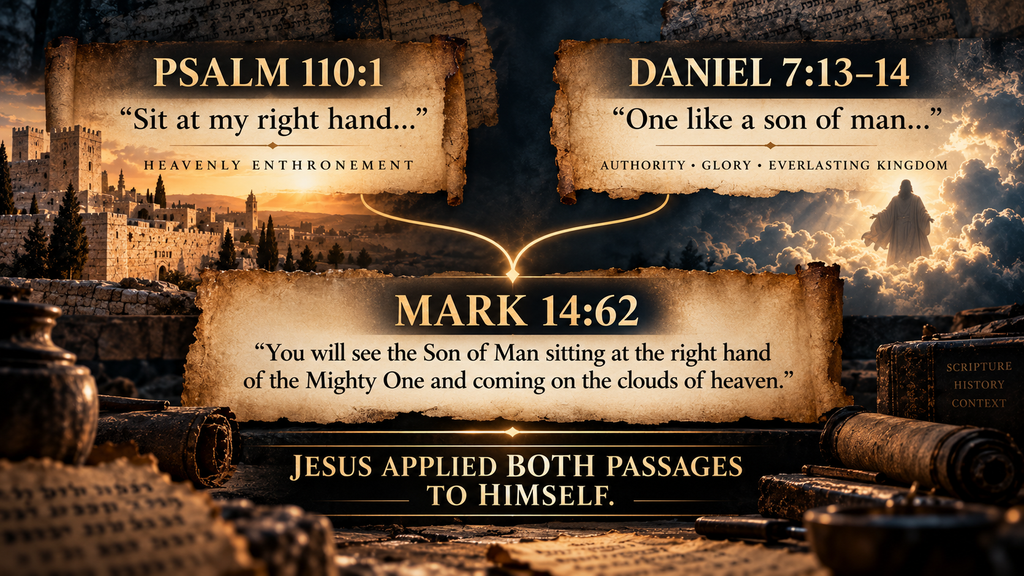
“I am. And you will see the Son of Man sitting at the right hand of the Mighty One and coming on the clouds of heaven.”
Mark 14:62, NIV
Jesus combines imagery from two major Old Testament passages.
Psalm 110:1 describes David’s Lord sitting at God’s right hand. Daniel 7:13 describes the Son of Man coming with the clouds of heaven. Scholars recognize both texts behind Jesus’ answer in Mark.
The combination is extraordinary.
Recent scholarship has argued that Mark 14:62 presents two related stages: Jesus’ heavenly enthronement at God’s right hand and His future coming as the glorious Son of Man. The imagery places Jesus within God’s heavenly rule rather than presenting Him as an ordinary earthly claimant to kingship.
The high priest understands Jesus’ answer as explosive.
He tears his clothes and accuses Jesus of blasphemy.
That reaction does not automatically settle every question about precisely what Jesus meant. It does show that Mark presents Jesus making an extraordinary claim about His heavenly identity and authority.
The man standing on trial tells his judges that they will ultimately see Him enthroned.
What Did Jesus Mean by “Before Abraham Was, I Am”?
John’s Gospel gives us some of Jesus’ most explicit statements about His identity.
During a dispute about Abraham, Jesus tells His opponents:
“Very truly I tell you, before Abraham was born, I am!”
John 8:58, NIV
Jesus does not merely say that He existed before Abraham. His unusual use of “I am,” or ego eimi in Greek, has generated extensive discussion because of its possible relationship to Old Testament language about God.
We should handle that connection carefully.
The Greek expression ego eimi does not automatically mean someone claims deity whenever they use it. Ordinary people could use the same words to identify themselves. Context determines their significance.
John 8 provides an extraordinary context.
Jesus contrasts Abraham’s beginning with His own existence and declares, “I am.” His opponents then pick up stones. Scholarship has consequently devoted considerable attention to the statement as part of John’s presentation of Jesus’ divine identity.
Whatever someone concludes about the precise Old Testament allusion, Jesus claims existence before Abraham.
That is not the statement of an ordinary first-century teacher.
What Did Jesus Mean by “I and the Father Are One”?
John records another confrontation in chapter 10.
Jesus speaks about His sheep and says nobody can take them from His hand. He then says nobody can take them from His Father’s hand.
Then comes the statement:
“I and the Father are one.”
John 10:30, NIV
His opponents again pick up stones.
Jesus asks which good work has caused them to stone Him. They answer that the issue is not His good works but what they regard as blasphemy.
Their accusation is revealing:
“You, a mere man, claim to be God.”
John 10:33, NIV
We still need to interpret Jesus through the entire Gospel rather than relying solely on His opponents’ accusation. Yet John clearly wants his readers to confront the question of Jesus’ relationship with God.
Jesus distinguishes Himself from the Father throughout John. At the same time, John presents an extraordinary unity between Father and Son.
Christian theology preserves both truths.
Jesus is not the Father.
Jesus is God the Son.
If Jesus Is God, Why Does He Pray to the Father?
This question follows naturally from passages where Jesus distinguishes Himself from God the Father.
Jesus prays to the Father. He obeys the Father. He speaks about being sent by the Father. He even refers to the Father as greater than Himself in John 14:28.
Does that prove Jesus cannot be God?
Only if Christianity teaches that Jesus is the Father.
It does not.
Historic Christian doctrine teaches one God who eternally exists as Father, Son, and Holy Spirit. The three persons are distinct without becoming three separate gods. Jesus can therefore speak to the Father without speaking to Himself.
The Incarnation adds another essential truth. The eternal Son truly became human.
Jesus did not merely appear human. He became fully human while remaining fully divine. His earthly life therefore includes genuine human obedience, suffering, prayer, hunger, fatigue, and ultimately death.
Distinction between Father and Son supports Trinitarian theology rather than refuting it.
Did Jesus Accept Worship?
The New Testament also describes people responding to Jesus with worship.
After Jesus walks on the water in Matthew 14, the disciples worship Him and identify Him as God’s Son. Matthew 28 describes the risen Jesus receiving worship from His disciples.
John gives us an especially powerful example through Thomas.
Thomas initially refuses to believe Jesus has risen unless he sees the wounds himself. When Jesus later appears, Thomas responds:
“My Lord and my God!”
John 20:28, NIV
Jesus does not rebuke Thomas for blasphemy.
Instead, He responds to Thomas’ belief.
This scene appears near the climax of John’s Gospel. John then tells readers that he recorded these signs so they might believe Jesus is the Messiah and Son of God.
The Gospel that begins by declaring that the Word was God ends its central Resurrection narrative with a disciple addressing Jesus as God.
Did Jesus Claim Authority to Judge Humanity?
Jesus also claims a role that Scripture associates with God’s judgment.
John 5 says the Father has entrusted judgment to the Son. Jesus says the purpose is that all may honor the Son just as they honor the Father.
That statement deserves careful attention.
Jesus does not merely claim that people should respect Him as a prophet. He connects the honor due to Himself with the honor due to the Father.
The Synoptic Gospels also connect Jesus with final judgment.
In Matthew 25, the Son of Man comes in glory, sits upon His throne, gathers the nations, and separates humanity for judgment. Once again, Daniel 7 stands in the background.
Jesus places Himself at the center of humanity’s final accountability before God.
Did Jesus Say, “Anyone Who Has Seen Me Has Seen the Father”?
During Jesus’ final teaching before the Crucifixion, Philip makes a request:
“Lord, show us the Father and that will be enough for us.”
John 14:8, NIV
Jesus responds:
“Anyone who has seen me has seen the Father.”
John 14:9, NIV
Jesus does not mean that He and the Father are the same person. The surrounding conversation repeatedly distinguishes Father and Son.
Instead, Jesus claims to reveal the Father uniquely.
This fits John’s opening description of the Son. John 1 presents the Word as existing with God and as God, then says the Word became flesh. Jesus makes the unseen God known.
Christianity therefore does not begin Jesus’ divine identity at Bethlehem.
The Son existed before His human birth.
Did the Earliest Christians Believe Jesus Was God?
A common alternative argument accepts that later Christians believed Jesus was divine but denies that the earliest Christians did.
According to this theory, Jesus began as a Jewish teacher. His followers gradually elevated Him after His death, and later generations eventually transformed Him into God.
The New Testament chronology makes a simple version of that theory difficult to maintain.
Paul’s letters predate the written Gospels in the surviving New Testament collection. Yet they already contain remarkably elevated claims about Jesus.
Philippians 2 describes Christ existing in the form of God before taking the form of a servant. Paul then describes His humiliation, death, exaltation, and universal lordship.
In 1 Corinthians 8:6, Paul speaks of “one God, the Father” and “one Lord, Jesus Christ.” Rather than placing Jesus outside Jewish monotheism, Paul places Father and Son within his confession about God and creation.
Scholars debate how and when the earliest Christians developed their Christology. They also debate particular passages and the meaning of individual titles.
What cannot easily be maintained is that Jesus’ divine status first appeared centuries later.
High claims about Jesus appear extraordinarily early.
Did Constantine or the Council of Nicaea Make Jesus God?
Another popular claim moves the development much later.
According to this version, Christians originally regarded Jesus as human until Emperor Constantine or the Council of Nicaea declared Him divine in AD 325.
The chronology makes that impossible.
Paul’s letters precede Nicaea by roughly three centuries. John’s Gospel also predates the council by more than two centuries and contains unmistakably high claims about Jesus.
Nicaea therefore did not invent the question of Jesus’ deity.
The council addressed a dispute over how Christians should understand the relationship between the Father and the Son. Christians were already worshiping Jesus and debating His divine identity long before Constantine entered the discussion.
We will examine Nicaea and the development of Christian doctrine in a dedicated article because the subject deserves more than a paragraph.
For now, the important point is chronological.
Constantine did not turn Jesus into God.
Doesn’t “Son of God” Mean Jesus Is Less Than God?
Modern readers sometimes hear “Son of God” and imagine biological reproduction. They assume a son must come into existence after his father and therefore cannot share the same eternal nature.
Christianity teaches nothing of the sort.
God did not physically produce Jesus.
The title must be understood within Scripture’s own categories. Its meaning depends on context, and the New Testament uses several overlapping titles to describe Jesus.
John makes the relationship particularly clear.
The Son existed with the Father before creation. Through Him all things came into existence. The Word became flesh without beginning His existence at the Incarnation.
Jesus is therefore not a created offspring of God.
He is the eternal Son.
What About Verses Where Jesus Appears Subordinate to God?
These passages deserve serious attention because critics often raise them against Christ’s deity.
Jesus says the Father sent Him. He obeys the Father. He says He does the Father’s will. In Mark 13:32, He says the Son does not know the day or hour of His return.
Christians should not hide those verses.
They belong to the same New Testament that presents Jesus in divine categories.
The doctrine of the Incarnation developed precisely because Christians had to account for both sets of evidence. Jesus possesses a genuine human nature and a genuine divine nature. Scripture neither collapses His humanity into His deity nor reduces His deity to His humanity.
Jesus is fully God and fully man.
That truth creates profound theological questions, but difficult questions do not erase the evidence that produced them.
Did John’s Gospel Invent a Divine Jesus?
Some critics argue that Mark presents a human Jesus while John transforms Him into God decades later.
John certainly makes Jesus’ divine identity unusually explicit. That observation should not trouble Christians.
The problem comes when someone assumes that explicit language equals invention.
Mark already portrays Jesus forgiving sins, exercising authority over the Sabbath, identifying Himself with Daniel’s Son of Man, and claiming the position at God’s right hand. At His trial, Mark combines Daniel 7 with Psalm 110 in Jesus’ description of His heavenly authority. Scholars continue debating the exact eschatological meaning, but the scriptural combination itself is clear.
John develops these themes with greater theological explicitness.
That does not mean John created them from nothing.
It means we should read all four Gospels rather than forcing one Gospel to sound exactly like another.
So, Did Jesus Actually Claim to Be God?
If the question means, “Did Jesus repeatedly walk around saying the exact sentence ‘I am God’?” then the answer is no.
But that is the wrong historical question.
Jesus spoke within a Jewish scriptural world. He claimed authority to forgive sins. He declared Himself Lord of the Sabbath. He identified Himself with Daniel’s heavenly Son of Man and claimed the place at God’s right hand.
He claimed existence before Abraham.
He described a unique unity with the Father. He accepted worship. He placed Himself at the center of final judgment and said people should honor the Son as they honor the Father.
Then His followers proclaimed Him Lord after His Resurrection.
The cumulative evidence matters.
Jesus’ divine identity does not rest upon one isolated verse. It emerges through His words, His actions, His use of Scripture, the reaction of His opponents, and the testimony of His earliest followers.
That is why Christians confess something far greater than “Jesus was a good teacher.”
Jesus Is God the Son
At CHPTRXV, we do not stop with the historical conclusion that Jesus made extraordinary claims about Himself.
We believe those claims are true.
Jesus Christ is the eternal Son of God. He is fully God and fully man.
The Father is God. The Son is God. The Holy Spirit is God. Yet Christianity does not proclaim three gods.
There is one God.
Within the one divine essence exist three distinct persons: Father, Son, and Holy Spirit. The Son became human without ceasing to be God. Our examination of whether the Trinity is taught in the Bible or was invented later by the church explains the biblical and historical case in greater detail.
Jesus then did something no merely human teacher could accomplish.
He carried our sins to the cross.
He died.
And as we examine in our investigation of the historical evidence for the Resurrection, He bodily rose from the dead.
That Resurrection changes the question.
Jesus is not simply a religious teacher whose claims we can admire from a safe historical distance. If He is who He claimed to be, then every person must eventually answer the question Jesus asked His disciples.
“Who do you say I am?”
Matthew 16:15, NIV
Who Do You Say Jesus Is?
You may believe Jesus was a prophet, moral teacher, revolutionary, legend, or religious leader. You may have heard that Christians misunderstood Him and later transformed Him into something He never claimed to be.
Do not settle that question through slogans.
Read the Gospels.
Pay attention to what Jesus says and what He does. Examine the Scriptures He invokes. Ask why His opponents react as they do and why His earliest followers worship Him.
Then examine what happened after His Crucifixion.
Christianity does not ask you to believe that Jesus is God because a church council said so. The case begins much earlier, with Jesus Himself and the earliest testimony about Him.
Our broader investigation into why Christianity is true begins with the same challenge.
Put it to the test.
Jesus asked His disciples the question nearly two thousand years ago, and every generation must confront it again.
Who do you say He is?
Our answer is clear.
Jesus Christ is Lord.
Sources and Further Reading
The New Testament: Mark 2:1–28; Mark 12:28–37; Mark 14:53–65; Matthew 14:22–33; Matthew 25:31–46; Matthew 28:16–20; John 1:1–18; John 5:16–30; John 8:48–59; John 10:22–39; John 14:1–14; John 20:24–31; 1 Corinthians 8:4–6; Philippians 2:5–11.
The Hebrew Scriptures: Deuteronomy 6:4; Psalm 110:1; Daniel 7:9–14.
Murray J. Smith and Ian J. Vaillancourt, “Enthroned and Coming to Reign: Jesus’s Eschatological Use of Psalm 110:1 in Mark 14:62,” Journal of Biblical Literature 141.3 (2022): 513–531. Examines Jesus’ combination of Psalm 110 and Daniel 7 and argues for heavenly enthronement followed by His eschatological reign.
Young Namgung, “Reading John 8:31–59 in Context,” New Testament Studies in Korea 18.2 (2019): 119–146. Examines the literary and scriptural context of Jesus’ ego eimi declaration in John 8:58.
Elton L. Hollon, “Eschatological Interpretations of Mark 14:62,” Neotestamentica 58.2 (2024). Reviews competing interpretations of Mark 14:62 and its use of Daniel 7 and Psalm 110.
Related Reading
Why Believe Christianity Is True? Examine the Evidence
Did Jesus Really Rise From the Dead? Examining the Historical Evidence